Frederick
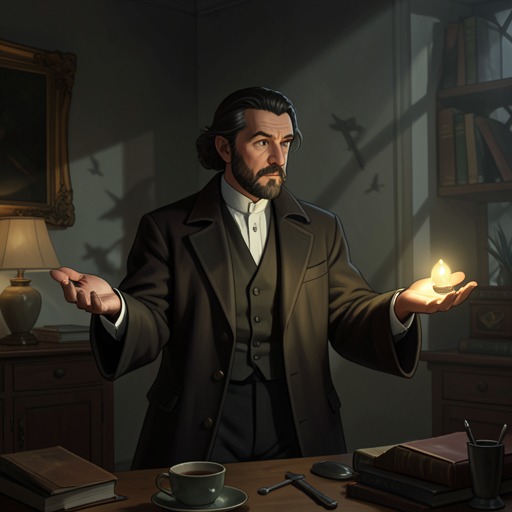
The Magician's ElephantFrederick, the ageing magician of the Bliffendorf Opera House, conjures an elephant when he means to produce a bouquet of lilies. The feat is the most astonishing magic of his career, but its wonder is inseparable from its consequences: the elephant smashes through the theatre roof and lands on Bettine LaVaughn, crippling her. Frederick’s story turns on the gap between making something extraordinary and accepting responsibility for what that act has set in motion.
Identity and First Performance
Frederick is introduced as a magician of advanced years whose reputation is failing. At the Bliffendorf Opera House, he intends to present lilies to Bettine LaVaughn. Instead, an elephant bursts through the ceiling amid plaster dust and roofing tiles, landing in the noblewoman’s lap. The contrast between the small, deliberate gift he planned and the immense, destructive arrival he causes defines the performance: it is a marvel, but not one he can control or contain.
The Spell and Its Consequences
The accident creates a legal and moral problem for the police. Baltese’s chief of police searches the handbook for guidance on a beast that has appeared from nowhere, destroyed a roof, and crippled a noblewoman, but finds no applicable rule. One policeman proposes treating the elephant as a criminal. Leo Matienne challenges that reasoning by separating the cause of the damage from the creature made to bear blame: the elephant did not choose to crash through the roof, and should not be guilty of an event she did not will.
The distinction exposes the reach and the limits of Frederick’s act. The elephant is the visible agent of the wreckage, but the police discussion points back to the magician’s conjuring as its cause. The legal debate does not give Frederick control over what follows; instead, the elephant is placed within systems of custody and private possession. The Countess Quintet has a dozen craftsmen work around the clock to knock down a wall and install an enormous painted and decorated door. The chief of police escorts the elephant through it under cover of night, and the countess claims her as property. Frederick’s extraordinary performance thus leads not simply to a damaged theatre, but to the elephant’s confinement in the countess’s home.
Regret and the Attempt to Undo the Magic
When confronted with the possibility of sending the elephant back, Frederick says that he has tried before and failed. His tears accompany a revealing admission: he did not want to return her, because she was the finest magic he had ever performed. His attachment to the achievement has therefore helped keep the elephant from home. Leo Matienne counters that returning her to where she belongs would itself be a fine act of magic. Frederick does not immediately accept this redefinition; he looks from Leo to Peter and back again before the decision moves toward action.
At the later attempt, Frederick recalls the star he watched from his prison cell, the snow that finally fell, and his wish to have someone beside him to see it. He also remembers Bettine LaVaughn looking up at him with questioning hope. He speaks the spell backwards, quietly and completely, with hope that it will work and awareness that even a magician cannot undo everything. The snow stops. The scene gives his reversal both a practical and an ethical dimension: he tries to relinquish the wonder he once prized in order to restore the elephant to her home, while recognizing that reversal cannot erase every consequence.
Life After the Spell
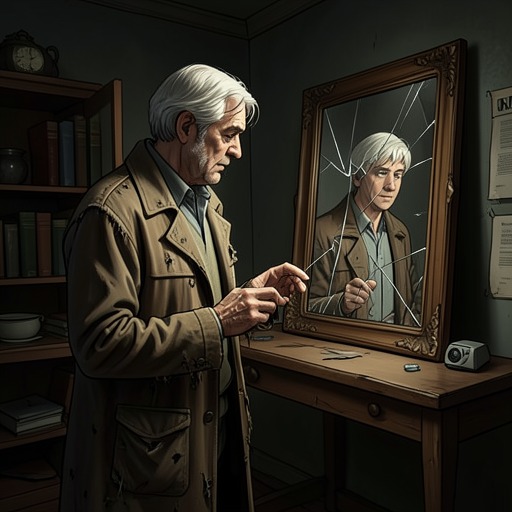
Frederick later becomes a goatherd and marries a woman who has no teeth. They love one another and live with their goats in a hut at the foot of a steep hill. On summer evenings they climb the hill together to look at the constellations. He shows his wife the star he watched so often in prison and felt had kept him alive, though he cannot identify it with certainty, pointing first to one star and then another.
This quiet ending changes the scale by which his life is measured. The magician who once prized the elephant as the finest performance of his career now shares the night sky with another person, offering the star that sustained him rather than claiming certainty about it. His arc does not erase the harm caused by his magic; it places that harm beside his eventual effort to send the elephant home and a later life shaped by companionship rather than spectacle.